Six rules for the water on a Crystal River manatee swim
Swimming with wild manatees in Kings Bay comes with a short set of firm rules, and every guide will brief you on them before you get wet. They are easy to keep once you know why they exist. Below are the six that matter in the water, and what to do when a manatee swims up to you.
Where the rules come from
Kings Bay is one of the very few places in the US where people may legally swim with manatees. Its water belongs to the Crystal River National Wildlife Refuge, set up in 1983 for the manatees, and the rules that come with it are firm.
Before every swim, Explorida plays the "Manatee Manners" video, which its listing credits to the Florida Fish and Wildlife Conservation Commission. The idea running through it is passive observation. You watch from the surface, and the manatee decides how close it comes.
Your guide repeats the rules on the boat and will call you back if you drift into trouble. Nobody expects you to memorize a rulebook, because six habits cover almost everything that can go wrong in the water.
The six rules at a glance
- Float at the surface and never dive down onto a resting manatee
- Keep your hands to yourself, even when a manatee comes close
- Do not chase or surround a manatee
- Stay outside the roped-off sanctuary areas
- Kick slowly, or let the wetsuit hold you up
- Never feed a manatee or give it water
Each one sounds obvious on dry land. In cool water, with an animal of roughly 1,000 pounds drifting toward you, they are easier to forget, so the reasons behind each rule follow.
Rules for your body and your hands
1. Float at the surface
The swims are surface snorkeling. You lie face down in a wetsuit and watch the manatee below you through the mask, which is how the refuge wants it. Diving down toward a manatee resting on the bottom disturbs it and can push it away.
Manatees come up to breathe every few minutes, so if you stay put you will often see one rise past you. That slow climb toward the light is the moment many swimmers remember longest.
2. Keep your hands to yourself
No touching and no petting, however close the animal gets. Kacey's Custom Adventures puts it plainly in its listing, saying touching marine life is not allowed, and the swim operators teach the same line.
Folding your hands under your chest or holding them behind your back is the easy way to keep this rule. It also stops your arms from flailing, which unsettles a manatee far more than a swimmer floating still.
Rules for distance and space
3. Never chase or surround a manatee
If a manatee swims off, let it go. Following it, or forming a ring of snorkelers around it, cuts off its way to the surface and to deeper water. With up to 10 people in the water on Explorida's group swim, guides watch for this closely.
Give the animal a clear exit on at least one side. If you notice you are the only thing between a manatee and open water, back away slowly with small strokes.
4. Stay out of the sanctuary areas
In winter, parts of Kings Bay are roped off as manatee sanctuaries, and swimmers may not enter them. On the coldest mornings many manatees rest inside, so you may only see some of them from a distance.
Do not reach across the line or wave a manatee toward you. The same thinking closes the Three Sisters Springs spring run to swimmers and paddlers through the winter manatee season.
Rules for fins, food and water
5. Kick softly, or not at all
The bottom of Kings Bay is soft, and a few hard kicks turn clear water into a brown cloud for everyone behind you. The wetsuit already keeps you afloat, and Explorida adds a float noodle, so you hardly need to kick.
Loud splashing travels well under water too. A quiet group usually gets calmer, longer looks than a noisy one, because the manatees have no reason to move off.
6. Never feed a manatee or give it water
Feeding wild manatees, or offering them fresh water from a bottle or hose, teaches them to approach people and boats. That habit brings them close to propellers, so the rule holds even when a manatee seems to ask.
Keep snacks on the boat and drink your own water there. Explorida's listing includes bottled water on board, and that bottle is for you, not for the animals.
When a manatee comes to you
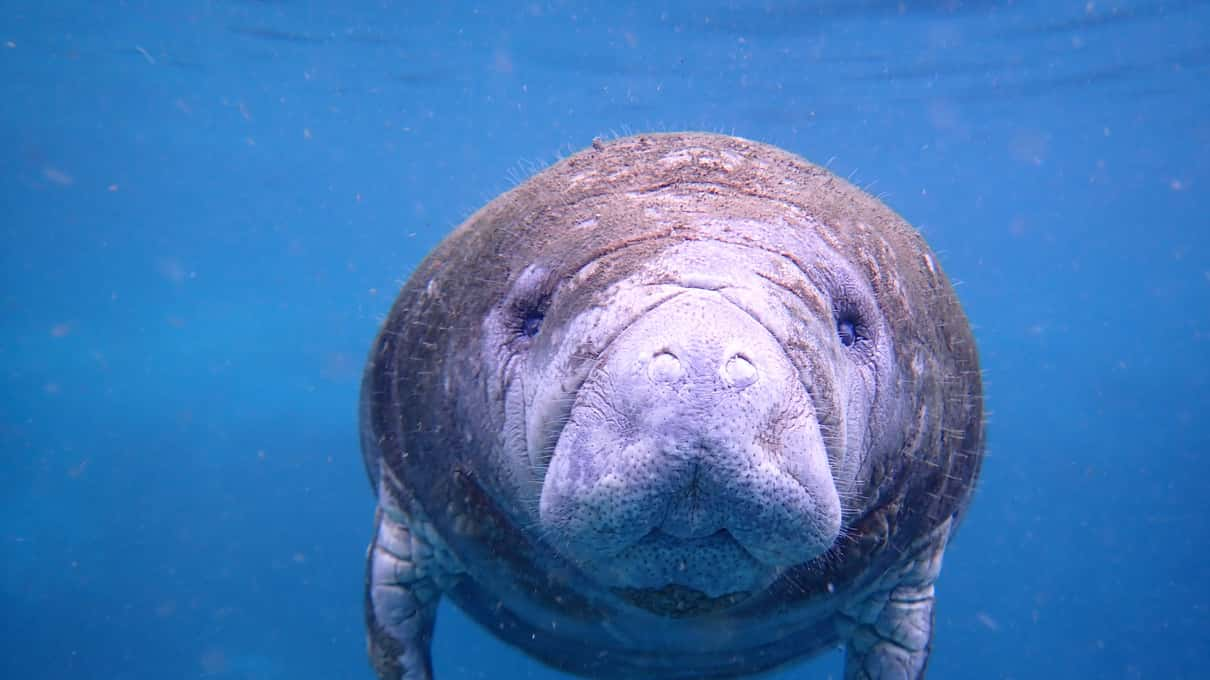
Sometimes a curious manatee swims straight up to a snorkeler or rolls over right alongside. You may let it, and stay still while it does. The rule against touching still stands, so keep your hands tucked in.
If it stays, float and enjoy the visit. If it leaves, do not follow it. Moving on gently when the guide calls the group is part of passive observation too.
None of this is promised. Manatees are wild, and Explorida's own listing says sightings are not guaranteed, so a close pass is luck rather than something a guide can arrange.
What stays on the boat
Drones are out, and Explorida lists them among the things not allowed on its tours. Alcohol is on the same list, so leave both at home.
Cameras are fine as long as you follow the same rules with one in your hand. No flash and no chasing for a better angle. Our guide to underwater photos covers how each tour handles pictures.
Gear and clothing are a separate question. The packing list for a manatee swim sorts out what the operators lend you and what you carry yourself.
Choosing a swim with a small group
All the swims on this site follow the same refuge rules, so the choice comes down to group size and comfort. Crystal River Manatee Adventures' semi-private swim from ~$76 keeps the boat to six guests at most, which makes the rules easier for everyone to keep.
Its boat is heated in winter and serves hot chocolate and coffee all year. It scores 5.0 from 500+ reviews on Viator, and its listing says it is not suitable for non-swimmers or people with heart problems.
Six guests, one guide in the water
The semi-private swim keeps the group small, with a USCG master captain and an in-water guide who also takes photos. Check your booking to see whether those photos are included.
For a larger group and a lower fare, Explorida's group swim at ~$69 takes up to 10 and lends float noodles. Nervous swimmers should first read whether non-swimmers can join, and parents can turn to manatee swims with kids.
Would you rather stay dry? The clear kayak tour from ~$79 and Explorida's viewing cruise at ~$50 keep the same hands-off idea from above the water. Our price comparison lines all four tours up side by side.